Is Headless Shopify Better for SEO? What the Data Says in 2026
Is headless Shopify better for SEO? Usually not on its own. I tested 60 Shopify stores in October 2026: here's the real-user speed data, the SEO plumbing a headless build has to rebuild, and the few cases where going headless does help rankings.
Is headless Shopify better for SEO? It's the first question to ask if someone has pitched you a headless rebuild, usually with the promise that "faster means higher rankings." The honest answer is shorter and less exciting than the pitch, and the real-user data doesn't back the hype.
Short answer: no, headless Shopify isn't better for SEO on its own. Google doesn't rank a store higher because it's headless. When I tested 60 well-known Shopify brands in October 2026, 44% of Liquid stores passed all three Core Web Vitals on mobile, against 29% of Hydrogen (headless) stores. A headless build also has to rebuild SEO features a Liquid theme gives you for free. Headless helps SEO in a few specific cases, like needing custom URL structures or running a content-heavy site, and those are covered below.
Is headless Shopify faster? We tested 60 stores in October 2026
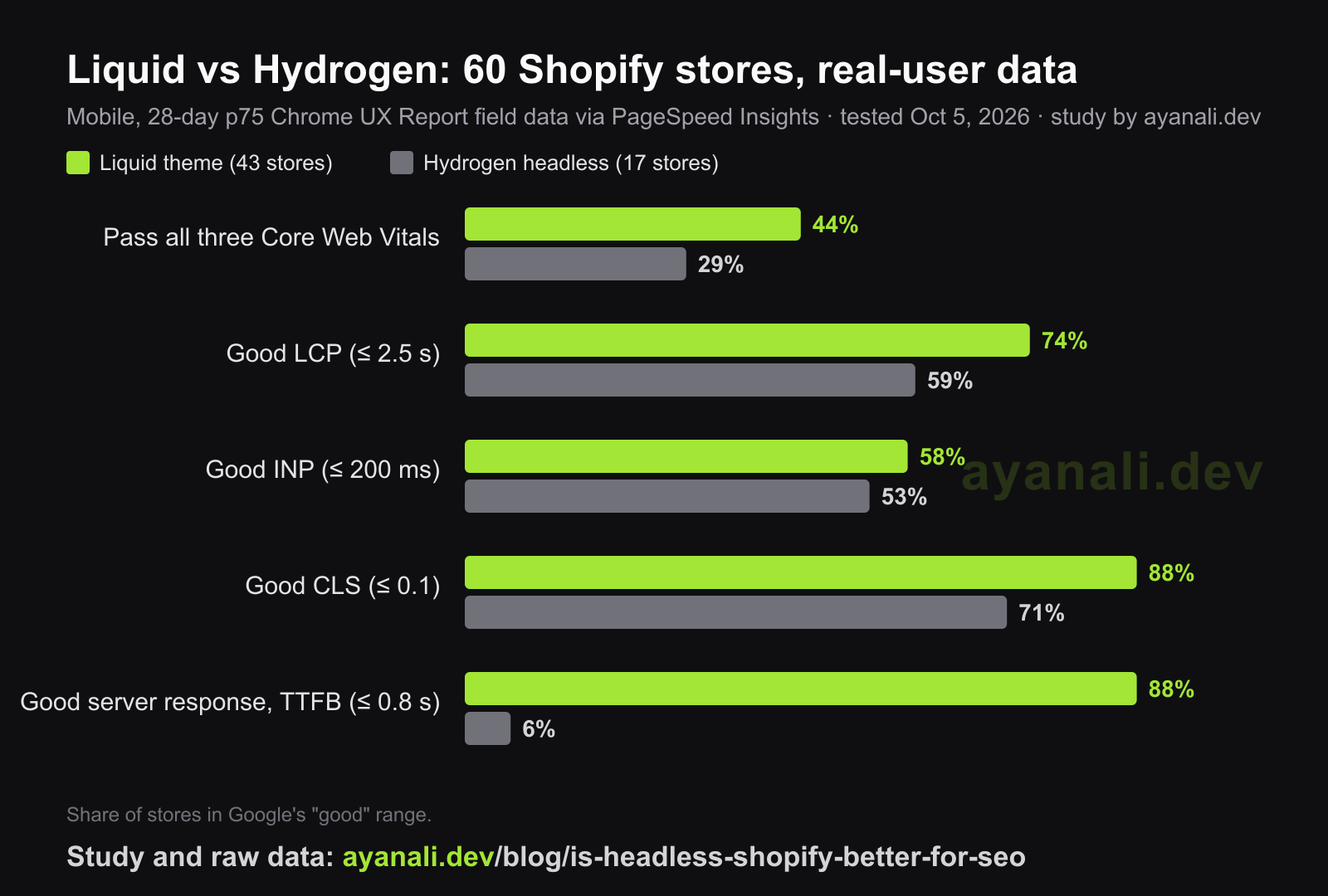
On October 5, 2026, I pulled Chrome's real-user speed data for 60 well-known Shopify brands: 17 running Hydrogen, Shopify's headless framework, and 43 running a regular Liquid theme. On mobile, 44% of the Liquid stores passed all three Core Web Vitals, compared with 29% of the Hydrogen stores. Liquid stores came out ahead on every metric.
| Mobile, real users (p75) | Liquid (43 stores) | Hydrogen (17 stores) |
|---|---|---|
| Pass all three Core Web Vitals | 44% (19 stores) | 29% (5 stores) |
| Good LCP (≤ 2.5 s) | 74% | 59% |
| Good INP (≤ 200 ms) | 58% | 53% |
| Good CLS (≤ 0.1) | 88% | 71% |
| Good TTFB (≤ 0.8 s) | 88% | 6% |
| Median LCP | 2.02 s | 2.44 s |
| Median INP | 188 ms | 200 ms |
| Median TTFB | 0.55 s | 1.37 s |
Source: my own study, October 5, 2026. Chrome UX Report field data via the PageSpeed Insights API. [Download the raw data (CSV)](https://res.cloudinary.com/dg6ia0wb7/raw/upload/v1791205277/portfolio/research/headless-shopify-seo-study-2026-10.csv), or re-run any store from the full table at the end of this article.
Server response time was the biggest gap between Liquid and Hydrogen stores. The median Hydrogen store took 1.37 seconds to start sending its homepage to real mobile visitors, against 0.55 seconds for the median Liquid store. Only one of the 17 Hydrogen stores (Fashion Nova) had a good Time to First Byte, compared with 38 of 43 Liquid stores. A slow first byte pushes back everything after it, including Largest Contentful Paint.
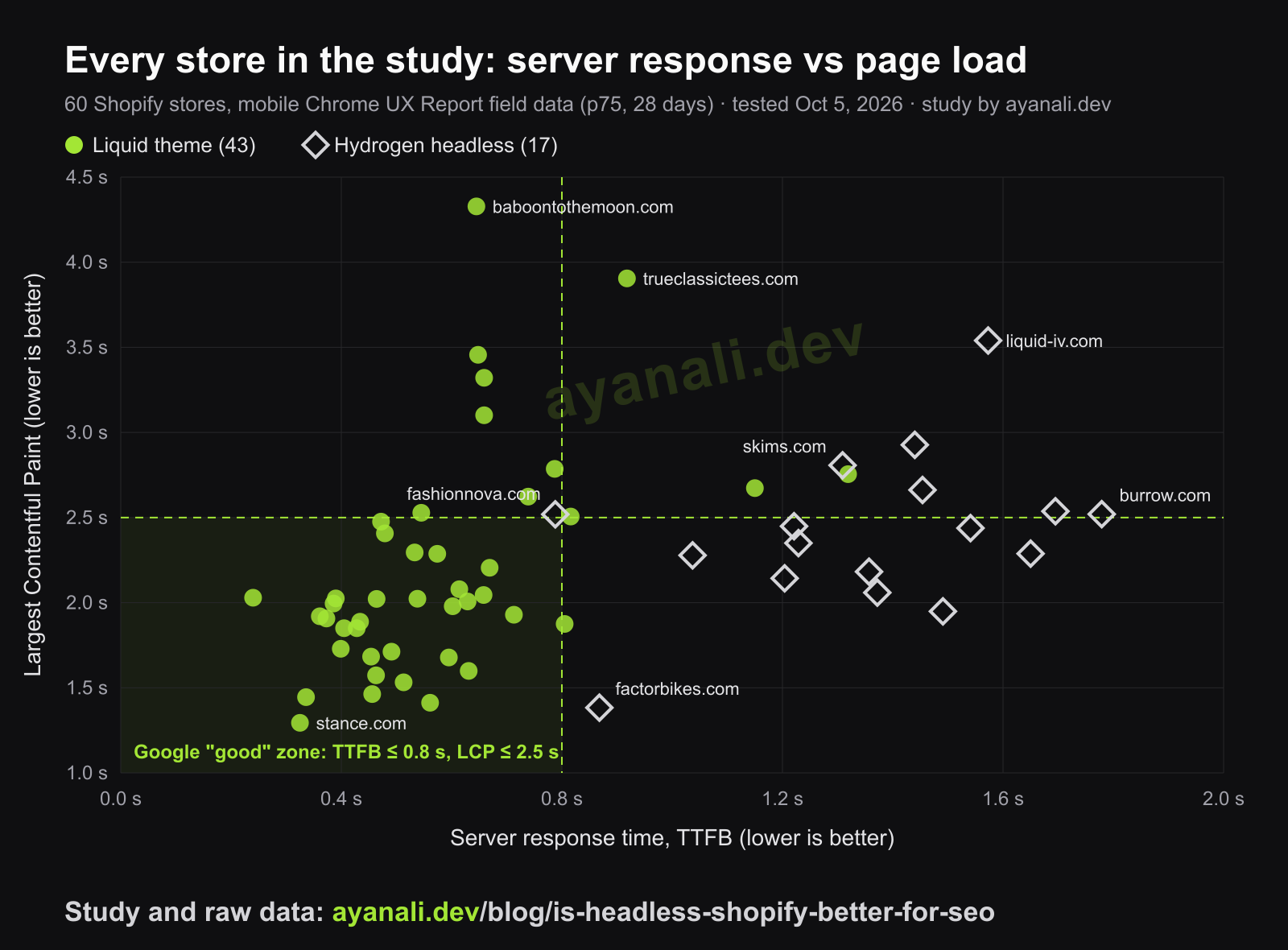
The store-by-store scatter plot shows the split clearly. Most Liquid stores cluster in the bottom-left "good" zone, where server response is under 0.8 seconds and LCP is under 2.5 seconds. Sixteen of the 17 Hydrogen stores sit to the right of the 0.8-second line, with server response times between 0.86 and 1.78 seconds, and Fashion Nova sits just inside it at 0.79. Plenty of Hydrogen stores still keep LCP under 2.5 seconds, which means those teams are doing good work on the front end to make up for a slower start.
Hydrogen stores can pass Core Web Vitals, and five in the study did: BYLT Basics, Factor Bikes, Manly Bands, Manors Golf and Nour Hammour. Factor Bikes had the fastest LCP of any Hydrogen store at 1.38 seconds. That points to build quality, not the framework, as what decides speed. A carefully built Hydrogen store can be fast, and a careless Liquid store can be slow (Baboon to the Moon's Liquid store had a 4.33-second LCP).
How the study was done
The 60 stores came from two places: brands named as Hydrogen examples in public agency roundups and showcase lists, and well-known DTC brands of a similar profile running Liquid. I fetched each homepage on October 5, 2026 and classified it by two signals. A store counted as Hydrogen only if it sent the response header powered-by: Shopify, Oxygen, Hydrogen and its HTML contained Remix or React Router markup. A store counted as Liquid if its HTML contained Shopify theme markup (Shopify.theme) and no Hydrogen header. I left out Shopify's own hydrogen.shop demo and Shopify Supply, plus Western Rise, which had no Chrome field data.
The speed numbers are origin-level Chrome UX Report field data, pulled through the PageSpeed Insights API on mobile. Origin-level CrUX data is a 28-day rolling 75th percentile across every page of a site, from real Chrome users, and it's the same dataset Google uses for its page experience signal. A store "passes" when its LCP, INP and CLS are all inside Google's "good" thresholds.
The study has limits worth knowing. It's 60 stores, not a random sample, and the Hydrogen brands skew larger and more image-heavy than the average Liquid store. The data shows how these stores perform, not why, so it can't prove that Hydrogen itself causes slower pages. You can check any store's stack yourself by running curl -sI https://skims.com | grep -i powered-by in a terminal, or by looking at the response headers in your browser's DevTools.
Are the popular "Hydrogen examples" still on Hydrogen?
Ten brands that agency roundups list as Shopify Hydrogen examples were serving a regular Liquid theme on their homepage on October 5, 2026: Allbirds, Good American, Denim Tears, NOBULL, Toms, UMZU, Blume, Baboon to the Moon, Victoria Beckham Beauty and Heights. Gymshark, another frequently listed example, didn't show Hydrogen's markers either. I can't see why each brand moved, and some may still use Hydrogen in other regions or on other pages. Still, if an agency's pitch leans on a list of famous Hydrogen stores, check what those stores run today before you treat the list as proof.
Does Google rank headless sites higher?
Google doesn't rank a site higher for being headless. Googlebot never sees "Hydrogen" or "Next.js." It sees the HTML a page returns, the content in it, and how fast that page loads for real visitors. A headless Shopify store and a Liquid Shopify store with the same content, the same speed and the same links will rank the same.
Page speed does matter for SEO, but less than most headless Shopify pitches suggest. Google's page experience documentation says Core Web Vitals "are used by our ranking systems." The same page also says Google "always seeks to show the most relevant content, even if the page experience is sub-par." So a faster store gets a tie-breaker, not a free pass past better content.
What did Shopify's own data show about Liquid vs headless?
Shopify's own data points the same way as my 2026 study. Shopify's performance team pulled real-user data from the Chrome UX Report and published it in Liquid vs headless: a look at real user web performance. Here's what they found for September 2023:
| Storefront type | Share passing all Core Web Vitals |
|---|---|
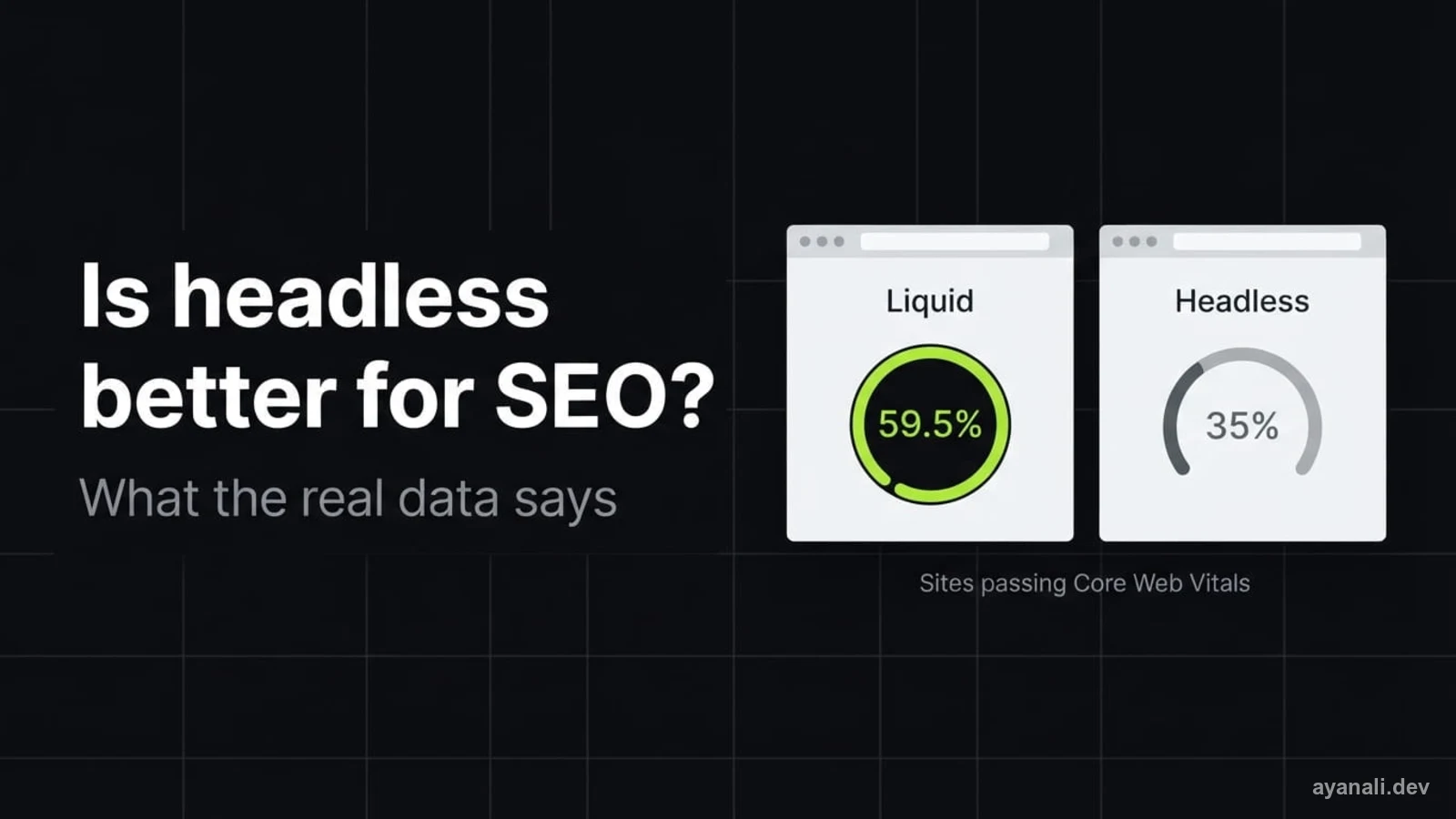
| Shopify Liquid | 59.5% |
| All websites | 43% |
| Hydrogen (Shopify's headless framework) | 35% |
| Next.js | about 28–29% |
| Remix | about 28–29% |
| Nuxt.js | 22% |
Source: [Shopify Performance, CrUX data via the Core Web Vitals Technology Report](https://performance.shopify.com/blogs/blog/liquid-vs-headless-a-look-at-real-user-web-performance).
Shopify's Liquid vs headless numbers come with two caveats: they're from 2023, and the framework buckets include non-ecommerce sites, so Shopify itself calls the comparison "directional." On server response time, 78% of Shopify Liquid domains had a good Time to First Byte, which is a big part of why Liquid storefronts score so well.
Hydrogen had caught up on interactivity by then. In Shopify's analysis, 75% of Liquid sites and 74% of Hydrogen sites had a good Interaction to Next Paint (INP) score, while Next.js, Nuxt and Remix were all under 40%. If a headless build is done carefully on Hydrogen, it can match a Liquid theme. It just doesn't beat one by default.
You can check the current numbers yourself in the free Core Web Vitals Technology Report from HTTP Archive. Pick "Shopify" and "Hydrogen" (or any framework) and compare the percentage of sites with good Core Web Vitals on mobile.
Why are Liquid themes so hard to beat on speed?
Liquid themes are rendered on Shopify's own servers and served from Shopify's CDN, which Shopify has spent years tuning for exactly one job: ecommerce pages. Images get automatic format conversion and resizing through Shopify's image CDN, and the HTML arrives fully rendered on the first request. A headless store has to get all of that right itself.
Most slow Shopify stores are slow because of apps and theme code, not because of Liquid. Upsell widgets, review apps, chat bubbles and tracking scripts all load on top of the theme. A headless rebuild often "fixes" speed simply by leaving those apps behind, which you could also do on Liquid for a fraction of the cost. I've written up how to speed up a Shopify store without apps step by step.
What SEO features do you have to rebuild on headless Shopify?
A Liquid theme hands you a lot of SEO plumbing for free. On headless Shopify, the frontend team owns every one of these pieces:
| SEO feature | Liquid theme | Headless (Hydrogen or custom) |
|---|---|---|
| sitemap.xml | Generated automatically | Must build a route (Hydrogen `getSitemap`) |
| robots.txt | Automatic, editable via robots.txt.liquid | Must build a route |
| Canonical tags | Handled by the theme | Must set on every route |
| URL redirects from Shopify admin | Work automatically | Only if the frontend checks them (Hydrogen's storefrontRedirect) |
| Product structured data | In most themes | Must write JSON-LD yourself |
| hreflang for Shopify Markets | Added automatically | Must build per locale |
| Review stars, app blocks | Install the app | Needs API integration or a headless-ready app |
| Server-rendered HTML | Always | Only if SSR is set up correctly |
Hydrogen makes most of this manageable. Shopify's Hydrogen SEO docs cover a getSeoMeta utility for titles, canonicals and JSON-LD, plus generators for sitemap.xml and robots.txt routes. Hydrogen's default sitemap example stops at 250 products, 250 collections and 250 pages unless you add pagination, so a large Shopify catalogue needs extra work before every product is in the sitemap.
Redirects are where headless migrations most often lose traffic. Headless projects nearly always change some URLs, and any old URL without a 301 redirect turns into a 404 for both shoppers and Google. On Hydrogen, redirects you add in Shopify admin only work if the frontend calls storefrontRedirect when a route isn't found. On a custom Next.js build, you have to wire up redirects yourself.
The old Liquid storefront doesn't disappear when you go headless. Your .myshopify.com Online Store can still be reachable and indexable, which creates duplicate copies of every product page. Either password-protect it or redirect it to the new frontend before launch.
When is headless Shopify actually better for SEO?
Headless Shopify can be better for SEO in a few specific situations. If none of these fit your store, a faster Liquid theme will almost always do more for rankings per dollar spent.
You need full control over URLs. Shopify's Liquid storefront forces fixed prefixes like /products/, /collections/ and /pages/, and you can't remove them. A headless frontend can use any URL structure, which matters when you're migrating a big site with years of rankings on a different structure.
You're a content-heavy brand. If your SEO strategy depends on hundreds of guides, recipes or editorial pages, a headless setup with a proper CMS (like Sanity or Contentful) gives your content team more layout and linking control than Shopify's blog does.
You run complex multi-region or multi-brand storefronts. Headless lets one codebase serve different brands, languages or regions with custom routing and per-region content. Shopify Markets covers a lot of this on Liquid now, so check that first.
You need app-like features that Liquid can't do well. Product configurators, heavy personalisation or a storefront that shares code with a mobile app are real reasons to go headless. SEO isn't one of them, but a headless build can still do SEO well if the team treats it as a requirement from day one.
How do you check if a headless Shopify store is SEO-friendly?
You can audit a headless Shopify store's SEO with free tools in under an hour. Start with these four checks.
- Look at what Google actually sees. In Google Search Console, use URL Inspection on a product page and click "View crawled page." If the product name, price and description are in that HTML, Google can read them. If the HTML is mostly empty
<div>tags, the page relies on client-side JavaScript and needs server-side rendering. - Test the structured data. Paste a product URL into Google's Rich Results Test. A product page should show valid "Product" markup with price and availability. If nothing shows up, the JSON-LD wasn't rebuilt.
- Check real-user speed. Run your key templates through PageSpeed Insights and read the field data at the top, not the lab score. The field data shows what real visitors experienced over the past 28 days.
- Crawl for broken links and redirects. Screaming Frog SEO Spider is free for up to 500 URLs and can render JavaScript. Crawl the site and filter for 404s, redirect chains and pages missing canonical tags.
If you're planning a migration, export your current URLs from Shopify and Search Console before launch, then crawl the new site against that list. Any old URL that returns a 404 needs a 301 redirect.
Should you go headless for SEO?
Going headless just for SEO is rarely worth it. A headless build costs more to build and maintain than a Liquid theme, and in both Shopify's 2023 data and my 2026 test of 60 stores, headless stores delivered worse real-user speed on average, not better. The SEO features a Liquid theme gives you free all have to be rebuilt and kept working.
The better path for most DTC brands is a well-built Liquid theme with fewer apps, custom-coded sections instead of app widgets, and the speed fixes that actually move Core Web Vitals. Go headless when you have a business reason Liquid can't handle, and make SEO a written requirement in the project scope when you do.
Full study data: 60 Shopify stores
Every store in the October 2026 study is below, with its mobile Chrome field data (75th percentile, 28 days). Click "PageSpeed" on any row to re-run that store today; numbers will drift as the 28-day window moves. LCP, INP and CLS are the three Core Web Vitals, and TTFB is server response time.
| Store | Stack | LCP | INP | CLS | TTFB | Passes CWV | Re-test |
|---|---|---|---|---|---|---|---|
| atoms.com | Hydrogen | 2.54 s | 205 ms | 0.04 | 1.70 s | No | PageSpeed |
| burrow.com | Hydrogen | 2.52 s | 138 ms | 0.18 | 1.78 s | No | PageSpeed |
| byltbasics.com | Hydrogen | 2.29 s | 179 ms | 0 | 1.65 s | Yes | PageSpeed |
| factorbikes.com | Hydrogen | 1.38 s | 137 ms | 0 | 0.87 s | Yes | PageSpeed |
| manlybands.com | Hydrogen | 2.06 s | 187 ms | 0.05 | 1.37 s | Yes | PageSpeed |
| manorsgolf.com | Hydrogen | 2.35 s | 172 ms | 0.02 | 1.23 s | Yes | PageSpeed |
| mejuri.com | Hydrogen | 1.95 s | 267 ms | 0 | 1.49 s | No | PageSpeed |
| nour-hammour.com | Hydrogen | 2.18 s | 145 ms | 0 | 1.36 s | Yes | PageSpeed |
| skims.com | Hydrogen | 2.81 s | 222 ms | 0.24 | 1.31 s | No | PageSpeed |
| us.carhartt-wip.com | Hydrogen | 2.14 s | 215 ms | 0 | 1.20 s | No | PageSpeed |
| carawayhome.com | Hydrogen | 2.28 s | 228 ms | 0.02 | 1.04 s | No | PageSpeed |
| chubbiesshorts.com | Hydrogen | 2.44 s | 200 ms | 0.31 | 1.54 s | No | PageSpeed |
| cutsclothing.com | Hydrogen | 2.93 s | 171 ms | 0.14 | 1.44 s | No | PageSpeed |
| fashionnova.com | Hydrogen | 2.52 s | 331 ms | 0.21 | 0.79 s | No | PageSpeed |
| liquid-iv.com | Hydrogen | 3.54 s | 261 ms | 0.01 | 1.57 s | No | PageSpeed |
| sandcloud.com | Hydrogen | 2.66 s | 196 ms | 0.06 | 1.45 s | No | PageSpeed |
| tecovas.com | Hydrogen | 2.45 s | 253 ms | 0 | 1.22 s | No | PageSpeed |
| athleticbrewing.com | Liquid | 1.73 s | 144 ms | 0.03 | 0.40 s | Yes | PageSpeed |
| baboontothemoon.com | Liquid | 4.33 s | 279 ms | 0.01 | 0.65 s | No | PageSpeed |
| brightland.co | Liquid | 1.68 s | 200 ms | 0.01 | 0.59 s | Yes | PageSpeed |
| colourpop.com | Liquid | 1.85 s | 212 ms | 0.15 | 0.41 s | No | PageSpeed |
| denimtears.com | Liquid | 2.29 s | 148 ms | 0 | 0.53 s | Yes | PageSpeed |
| drinkolipop.com | Liquid | 2.41 s | 155 ms | 0.09 | 0.48 s | Yes | PageSpeed |
| flamingoestate.com | Liquid | 1.98 s | 124 ms | 0.03 | 0.60 s | Yes | PageSpeed |
| fromourplace.com | Liquid | 2.79 s | 161 ms | 0.01 | 0.79 s | No | PageSpeed |
| kith.com | Liquid | 2.02 s | 139 ms | 0 | 0.39 s | Yes | PageSpeed |
| knix.com | Liquid | 1.88 s | 238 ms | 0.01 | 0.81 s | No | PageSpeed |
| kyliecosmetics.com | Liquid | 1.89 s | 320 ms | 0.04 | 0.43 s | No | PageSpeed |
| liquiddeath.com | Liquid | 1.41 s | 148 ms | 0.01 | 0.56 s | Yes | PageSpeed |
| magicspoon.com | Liquid | 2.29 s | 178 ms | 0.07 | 0.57 s | Yes | PageSpeed |
| nobullproject.com | Liquid | 2.62 s | 187 ms | 0.08 | 0.74 s | No | PageSpeed |
| oddli.com | Liquid | 1.92 s | 110 ms | 0 | 0.36 s | Yes | PageSpeed |
| olaplex.com | Liquid | 2.75 s | 235 ms | 0.04 | 1.32 s | No | PageSpeed |
| pangaia.com | Liquid | 1.71 s | 162 ms | 0 | 0.49 s | Yes | PageSpeed |
| parachutehome.com | Liquid | 2.67 s | 187 ms | 0 | 1.15 s | No | PageSpeed |
| rothys.com | Liquid | 2.21 s | 154 ms | 0.03 | 0.67 s | Yes | PageSpeed |
| thursdayboots.com | Liquid | 2.02 s | 123 ms | 0 | 0.54 s | Yes | PageSpeed |
| victoriabeckhambeauty.com | Liquid | 2.51 s | 305 ms | 0.01 | 0.82 s | No | PageSpeed |
| wildone.com | Liquid | 2.04 s | 218 ms | 0.02 | 0.66 s | No | PageSpeed |
| allbirds.com | Liquid | 1.57 s | 188 ms | 0 | 0.46 s | Yes | PageSpeed |
| aloyoga.com | Liquid | 3.10 s | 237 ms | 0.18 | 0.66 s | No | PageSpeed |
| blume.com | Liquid | 1.53 s | 229 ms | 0.02 | 0.51 s | No | PageSpeed |
| bonne-maman.com | Liquid | 1.68 s | 191 ms | 0.07 | 0.45 s | Yes | PageSpeed |
| brooklinen.com | Liquid | 3.32 s | 271 ms | 0.12 | 0.66 s | No | PageSpeed |
| cotopaxi.com | Liquid | 2.03 s | 195 ms | 0.14 | 0.24 s | No | PageSpeed |
| everlane.com | Liquid | 1.85 s | 271 ms | 0.01 | 0.43 s | No | PageSpeed |
| glossier.com | Liquid | 2.08 s | 221 ms | 0.1 | 0.61 s | No | PageSpeed |
| goodamerican.com | Liquid | 1.60 s | 279 ms | 0.01 | 0.63 s | No | PageSpeed |
| graza.co | Liquid | 3.46 s | 161 ms | 0 | 0.65 s | No | PageSpeed |
| gymreapers.com | Liquid | 2.01 s | 263 ms | 0 | 0.63 s | No | PageSpeed |
| heights.com | Liquid | 2.53 s | 167 ms | 0.05 | 0.55 s | No | PageSpeed |
| jonesroadbeauty.com | Liquid | 2.02 s | 216 ms | 0 | 0.46 s | No | PageSpeed |
| outdoorvoices.com | Liquid | 1.91 s | 171 ms | 0 | 0.37 s | Yes | PageSpeed |
| rarebeauty.com | Liquid | 2.00 s | 206 ms | 0.05 | 0.39 s | No | PageSpeed |
| stance.com | Liquid | 1.29 s | 129 ms | 0.01 | 0.33 s | Yes | PageSpeed |
| taylorstitch.com | Liquid | 1.45 s | 151 ms | 0 | 0.34 s | Yes | PageSpeed |
| tentree.com | Liquid | 1.46 s | 112 ms | 0.03 | 0.46 s | Yes | PageSpeed |
| toms.com | Liquid | 2.48 s | 386 ms | 0.14 | 0.47 s | No | PageSpeed |
| trueclassictees.com | Liquid | 3.90 s | 371 ms | 0.06 | 0.92 s | No | PageSpeed |
| umzu.com | Liquid | 1.93 s | 120 ms | 0.02 | 0.71 s | Yes | PageSpeed |
Related
- How to speed up a Shopify store without apps
- Shopify Core Web Vitals for Liquid themes
- Shopify checkout optimization for DTC brands
Sources
- Raw study data, October 2026 (CSV)
- Google: PageSpeed Insights API
- Google: Chrome UX Report
- Shopify Performance: Liquid vs headless, a look at real user web performance
- Google Search Central: Understanding page experience
- Shopify: Hydrogen SEO
- Shopify: Hydrogen getSitemap
- HTTP Archive: Core Web Vitals Technology Report
- Shopify: Hydrogen performance best practices
Frequently asked questions
Is headless Shopify better for SEO?
Not automatically. Google ranks content and relevance first. In a test of 60 Shopify brands in October 2026, 44% of Liquid stores passed all three Core Web Vitals on mobile against 29% of Hydrogen (headless) stores. Headless helps SEO only when it solves a specific problem, like Shopify's fixed URL structure or a content-heavy site.
Does Google rank headless sites higher?
No. Google doesn't know or care what framework a store is built with. It ranks the HTML it can crawl, the content on the page and signals like Core Web Vitals, which Google says are used in ranking but don't outweigh relevance.
Is Hydrogen faster than a Liquid theme?
It can be, but on average it isn't. In an October 2026 test of 60 Shopify brands using Chrome real-user data, the median Hydrogen store had a 2.44-second LCP and a 1.37-second server response, against 2.02 seconds and 0.55 seconds for the median Liquid store. Five of the 17 Hydrogen stores still passed all Core Web Vitals, so a careful Hydrogen build can be fast.
What SEO features do I lose when I go headless on Shopify?
You lose the theme's automatic sitemap, robots.txt, canonical tags, structured data and hreflang tags, plus storefront app blocks like review widgets. Hydrogen gives you helpers to rebuild most of these, but someone has to wire them up and test them.
Can I change Shopify's /products/ and /collections/ URLs?
Not on a Liquid theme. Shopify fixes those URL prefixes. A headless frontend can use any URL structure you like, which is one of the few SEO reasons to go headless.
How do I check if a headless store is SEO-friendly?
Run a page through Google Search Console's URL Inspection tool and look at the crawled HTML. If product names, prices and descriptions are in that HTML, Google can read them. Then check structured data with Google's Rich Results Test.
Not sure if headless is worth it for your store?
Book a free 15-minute consultation. We'll look at your current theme, your Core Web Vitals and what you actually want to build, and I'll tell you honestly whether a faster Liquid theme gets you there for a fraction of the cost. No obligation to hire me.